How can you balance space-saving requirements with patient/visitor comfort when selecting folding seating for hospitals?
Date: 2026-10-27 15:43:02
For institutional clients, the first step in choosing hospital folding seatings is not comparing prices, but rather defining the essential technical specifications that must be met during final inspection. Space efficiency is determined by the installation method and the chair's thickness when folded, while comfort depends on locking mechanisms, soft-close features, and the support provided by the seat. Both aspects should be incorporated into the procurement specifications as verifiable and enforceable requirements.
1. Prioritize load-bearing capacity and folding durability—the baseline for long-term reliability.
In a hospital environment, folding chairs must withstand frequent use by family members or caregivers, as well as occasional overloading. The steel tubing of the frame should have a wall thickness of at least 1.2 mm, with an overall load-bearing capacity of 150–200 kg. More importantly, look at static load testing and folding cycle durability. Some hospital procurement standards explicitly require the frame to remain undeformed under a 150 kg evenly distributed load for 24 hours, and to withstand at least 10,000 folding/unfolding cycles—all backed by a test report with CMA or CNAS accreditation. If these reports are missing, the product should be disqualified, regardless of how low the price may be.
2. Evaluate upholstery materials and infection control compliance; gaps in folding chairs are high-risk zones for healthcare-associated infections.
The seat surface should be made of medical-grade, antibacterial PU or PVC—materials that are waterproof, stain-resistant, and capable of withstanding repeated wiping with chlorine-based disinfectants. The material should demonstrate an antibacterial efficacy of ≥99% against common pathogens such as *Staphylococcus aureus* and *Escherichia coli*, supported by third-party test reports. Hinges and pivot points should ideally feature enclosed or easily wipeable designs to minimize crevices where dirt and bacteria can accumulate.
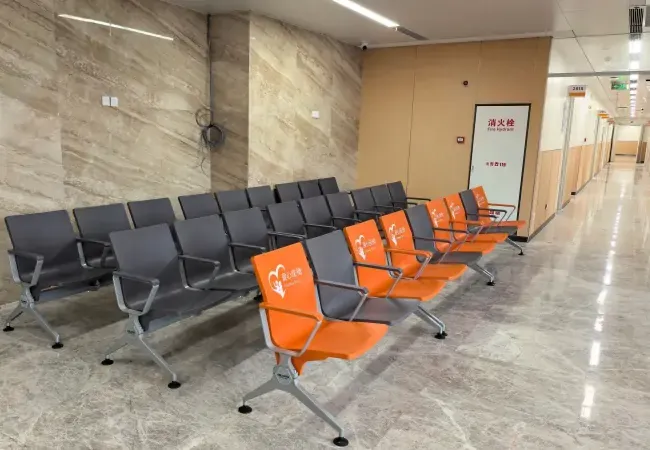
3. Consider the installation method to optimize space utilization.
Wall-mounted folding chairs can be retracted to a depth of approximately 23 cm from the wall, leaving the floor space completely clear; these are ideal for corridors, areas outside consultation rooms, and bedside seating in patient wards. Freestanding folding chairs, by contrast, are better suited for temporary seating areas that may require relocation. During the project selection phase, wall conditions must be verified in advance. Wall-mounted installations require structural studs or a reinforced substrate to support the load; they cannot be anchored directly to lightweight partition walls. Furthermore, it must be ensured that the unit, when in its folded/stowed position, does not encroach upon the clear width of evacuation routes—a strict requirement for fire safety compliance.
4. Finally, consider the total life-cycle cost.
Components such as cushions, upholstery, hinges, and pivot mechanisms are subject to wear and tear, typically with a service life of 3–5 years. When procuring, ensure that the supplier guarantees these parts can be replaced individually, rather than requiring the entire chair to be discarded. A warranty period of at least 24 months is a standard minimum requirement for public hospital procurement; the warranty duration for the structural frame should be verified separately.
RELATED NEWS