Why are more and more healthcare projects opting for customized infusion chairs?
Date: 2026-10-20 14:45:53
The core takeaway: The shift toward customized infusion chairs isn’t merely about aesthetics; it’s about resolving real-world clinical conflicts—specifically regarding infection control, patient positioning, and nursing workflows—that off-the-shelf, standardized chairs simply cannot address. Standard chairs, when purchased in bulk, often reveal their shortcomings as daily patient volume increases: seams in the upholstery trap dirt and become impossible to disinfect thoroughly; armrests remain stationary while the backrest is adjusted, causing IV lines to be pulled or tugged; and patients—such as those undergoing chemotherapy—may spend hours in a chair without even a dedicated space for their personal belongings.
1. The first level of customization addresses the strict requirements for infection control compliance.
In infusion rooms with high patient turnover, traditional chair upholstery is often stitched directly to the frame, allowing sweat and medication to seep into the needle holes—areas that cannot be reached or properly disinfected. Customized solutions allow for detachable seat and backrest covers, which can be removed—much like bed linens—for high-temperature drying or soaking disinfection, physically eliminating the gaps where dirt and pathogens accumulate. This is not merely an upgrade in comfort; it is a baseline requirement for passing hospital infection control inspections.
2. The second level of customization addresses the coordination between nursing procedures and patient positioning.
On standard infusion chairs, the armrests remain fixed when the backrest is reclined, which can pull on the patient’s arm and potentially displace IV lines. Customized designs can link the armrests to the backrest, ensuring they move in tandem when the backrest is reclined. This eliminates the need for nurses to pause their tasks to manually adjust the armrests. In settings like chemotherapy centers or day-surgery units, where patients undergo long-duration infusions, this detail is critical for both nursing efficiency and the safety of IV lines.
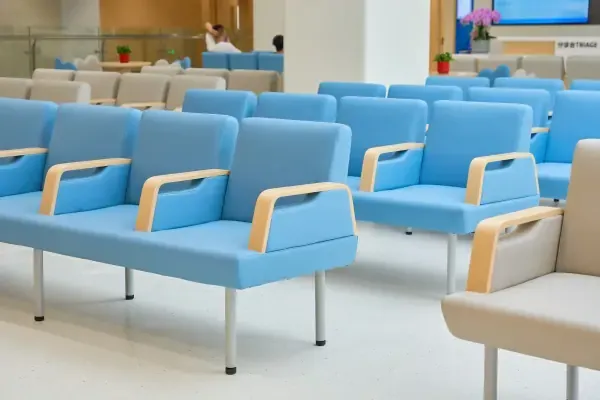
3. The third level of customization addresses the unique spatial constraints of different clinical departments.
Pediatric infusion areas may require rounded corners and lower seat heights; emergency infusion rooms often demand compact chair designs to fit into limited space; and VIP outpatient clinics might require integrated privacy partitions or built-in storage. The true value of customized infusion chairs lies not in "choosing colors," but in redefining dimensions, load-bearing capacities, and functional modules based on the specific clinical workflows and patient demographics of a given department.
When procuring customized infusion chairs, one non-negotiable prerequisite must be established: the supplier must hold a Class II medical device registration certificate that explicitly covers "infusion chairs" or "treatment chairs." Any "customization" offered without this certification is essentially just furniture manufacturing and fails to meet the compliance standards required for medical institutions. Beyond this, meaningful customization should incorporate specific technical requirements—such as modular, easily detachable components for infection control, synchronized armrest and backrest movement, and dimensions tailored to the department’s spatial constraints.
Ultimately, the core rationale for using customized infusion chairs in healthcare settings is to replace "make-do", off-the-shelf products with solutions designed for verifiable clinical utility. By ensuring robust infection control, sparing nurses from unnecessary bending, and minimizing the need for patients to shift their arms, the initial cost of customization is naturally amortized over the course of daily, long-term use.
RELATED NEWS