How Can Nurse Stations Optimize Space Utilization?
Date: 2026-04-28 15:05:38
The nurse station serves as the "central nervous system" of a hospital ward, handling a massive volume of daily tasks ranging from processing medical orders and receiving patients to temporarily storing medications and filing paperwork. However, in many hospitals, nurse station countertops are cluttered with documents, and corridors are so narrow that turning around is difficult—such inefficient space utilization directly hinders nursing efficiency. In reality, improving space utilization does not require physical expansion; the key lies in shifting from a two-dimensional floor plan approach to three-dimensional integration, utilizing a modular mindset to reimagine every inch of available space.
1. Reorganize Zones Based on Usage Frequency.
The most effective strategy is to zone the area according to workflow patterns: place high-frequency items (computers, telephones, frequently used forms) on the main countertop, within easy arm's reach; position medium-frequency items (printers, sanitizers) in side cabinets accessible with a simple turn; and store low-frequency items (backup supplies, archives) in tall cabinets or mobile carts. This "workflow triangle" layout minimizes unnecessary movement, thereby freeing up space for actual nursing procedures.
2. Modular Design: Reclaiming Floor and Countertop Space.
By breaking down the nurse station into independent units—such as main desks, side cabinets, tall storage units, and mobile carts—the layout can be freely configured to fit the specific dimensions and shape of the hospital ward. Another advantage of modularity is vertical utilization: by adding adjustable shelves and drawer dividers within tall cabinets, the clutter on countertops can be reduced by more than half. Hanging accessories—such as keyboard trays, shelving units, and waste bin baskets—also help "return" the countertop surface to its primary function as a workspace.
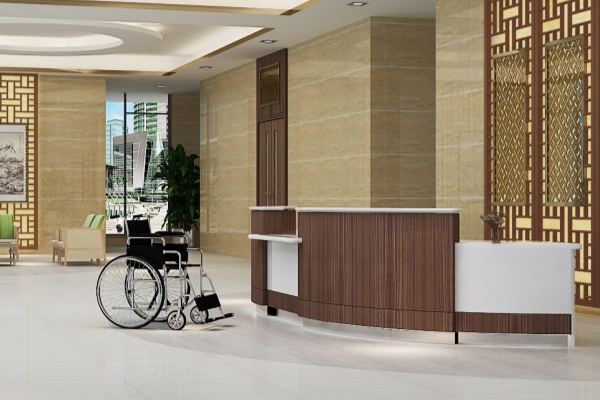
3. Turn Dead Corners into Functional Aids.
Corner spaces can be fitted with rotating shelves or fan-shaped pull-out baskets to store infrequently used items, such as IV sets. The open space beneath the workstation—beyond just housing the main computer tower—can be utilized to install slim drawers for storing small consumables. Wall surfaces serve as excellent platforms for light storage; magnetic whiteboards, document holders, and arrays of hooks can effectively declutter the desktop area. Side cabinets or mobile carts equipped with casters can be wheeled to the main desk during peak hours to serve as temporary auxiliary workstations, then returned to their designated spots once the rush subsides, without permanently occupying fixed floor space.
4. Smart Integration and Visual Organization.
Even simple smart accessories can boost efficiency; for instance, a flip-down monitor mount allows the screen to be stowed flush with the countertop when not in use, while integrated cable management channels prevent wires from becoming tangled. Standardizing colors and labeling—such as assigning different-colored folders to different shifts—reduces time spent searching and indirectly enhances spatial efficiency.
5. Customize the layout based on nursing staff habits.
The most practical approach is to observe the nursing team's actual workflow: Which drawers are the most difficult to open? Where do bottlenecks and queues frequently form? Use this data to adjust the placement of storage compartments, countertop depths, and aisle widths. For instance, positioning hand sanitizer and gloves on the outer side—closest to the nursing cart—minimizes the distance nurses must walk to retrieve them each time. Ultimately, spatial utilization serves the frequency and flow of human movement.
Achieving a highly efficient nursing station does not require extensive demolition or reconstruction. By simply implementing modular zoning, vertical storage solutions, corner utilization, and workflow optimization, a previously cluttered nursing station can be transformed into a well-organized workspace. When nurses are no longer hindered by spatial constraints, they can devote more of their energy back to patient care—and that is the true value of maximizing spatial efficiency.
RELATED NEWS