Why Are Hospitals Placing Increasing Emphasis on the Human-Centered Design of Patient Beds?
Date: 2026-05-12 15:21:35
In the past, hospital beds were viewed merely as "iron frames one could lie down on." Today, from top-tier tertiary hospitals to community health centers, the human-centered design of hospital beds has become a critical metric in procurement decisions. Driving this shift is the convergence of three key demands: enhanced patient experience, improved healthcare efficiency, and heightened medical safety.
1. Patient Experience: From "Curing Disease" to "Holistic Healing"
Hospitalization itself is an inherently stressful experience. Traditional manual beds require patients to exert considerable effort to crank a handle; in contrast, ergonomically designed electric beds allow patients to adjust backrest and leg heights with the touch of a button. Some even feature built-in smart anti-bedsore mattresses that automatically redistribute body pressure. Features such as guardrails requiring less physical effort to operate and soft, ambient night-light systems help reduce the risk of patient falls and alleviate nighttime anxiety. Studies indicate that comfortable medical nursing beds can shorten the average length of hospital stay—a metric that, for hospitals, translates into a higher bed turnover rate.
2. Healthcare Efficiency: Reducing Occupational Injuries
Nurses are required to bend down, push, pull, and manually raise beds dozens of times throughout their daily shifts. Electric lift beds allow the mattress platform to be adjusted to an optimal working height, eliminating the need for nurses to bend over when changing dressings or transferring patients, thereby significantly reducing the risk of lower back strain. Centralized braking systems make pushing the bed less physically demanding, while detachable headboards and footboards facilitate rapid access during emergency resuscitation procedures. Fundamentally, human-centered hospital nursing beds serve as tools designed to enhance job satisfaction among healthcare professionals.
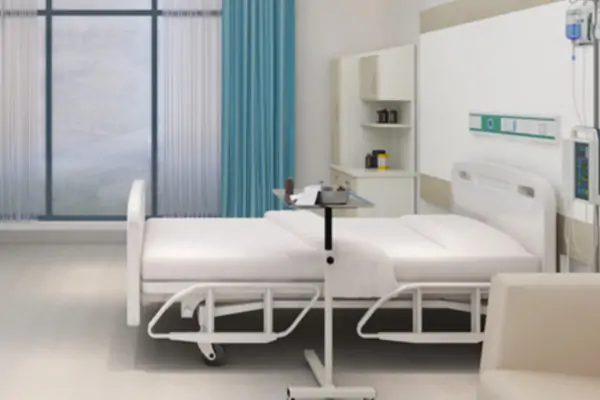
3. Safety and Infection Control
Precise spacing between guardrails on ICU beds, the rounded-edge design of ABS plastic beds, and the anti-tangle structures of bed casters—all these features directly mitigate the risks of patient entrapment and impact injuries. Furthermore, seamless, blow-molded headboards are easy to clean and feature no crevices where pathogens can hide; when combined with antimicrobial coatings, they effectively inhibit cross-infection. In essence, human-centered design serves as the first line of defense in hospital infection control.
4. Long-Term Procurement Value
On an increasing number of hospital procurement lists, multi-functional patient beds and specialized geriatric care beds are beginning to replace traditional iron-frame beds. Although the initial investment for human-centered electric medical beds may be slightly higher, the resulting reductions in patient complaints, nurse turnover rates, and maintenance costs demonstrate a clear return on investment—a calculation that savvy procurement professionals have long since mastered. In the future, hospital beds will no longer be mere cold pieces of machinery, but rather therapeutic platforms imbued with warmth. Human-centered design is transforming from a mere "bonus feature" into an absolute necessity.
RELATED NEWS